What do you think of Dickinson’s use of spacial relationships as it pertains to time/life events/etc.?

I’ve noticed in a lot of the poems that we have read that Dickinson approaches time and space uniquely. It seems like she uses physical space to suggest a sense of temporality, or maybe she uses space to altogether avoid time. I started thinking about this when we were discussing “A Wife — at daybreak I shall be” where instead of placing her future in time, she has it climbing stairs, moving from room to room. I also find it interesting that the imagery of a house itself is used frequently such as in “I heard a Fly buzz — when I died — ” where the scene is contained in a still room with windows. I myself am not sure what exactly what to make of it but was wondering what others make of her choice to contextualize events through physical, spatial relationships.

Poem #1313

I like what this poem says about the passage of time and how it can be subtle. “The dissembling Breeze” (4) hints without assuming, making the heart reflect on the things it doesn’t often consider. There’s a quiet emotion and reflection to this poem that is really interesting.

This is my work for April 2nd

Poem 552 discusses a “Languor of the Life / More imminent than Pain”. According to Dickinson’s Lexicon, languor means “the empty feeling of sorrow” or “longing for a lost loved one.” I interpret this poem as a commentary on the suffering that comes with the absence of feeling. Dickinson says, “A Dimness like a Fog / Envelopes Consciousness – / As Mists – obliterate a Crag.” To me this describes the erasure of self when depression and numbness take over the mind. Not only is the speaker becoming absent, but they are also being hidden from the rest of the world. The third and fourth stanzas speak to the danger of this. Pain is normal to the surgeon, but if told that the “Creature lying there” “ceased to feel,” he will admit defeat to forces “Mightier than He.” The absence of sensation indicates that “Skill is late” and it’s now hopeless. All life has been disconnected, as suggested by Dickinson’s use of the word “Creature.” This word strips the patient back to just their biology, erasing the layers that make us human, just as the loss of self and feeling does. The final stanza continues this idea through metaphysical concepts. Dickinson writes, “A Mightier than He – / Has ministered before Him,” implying that human intervention is pointless. “There’s no Vitality” left to save once the “Soul / Has suffered all it can.”

After reading this poem, poem 588 stood out to me for the way both poems address suffering and pain, though they approach these experiences differently. In poem 552, suffering is linked to numbness and the erasure of self, while poem 588 portrays pain and the absence of feeling through the metaphor of the heart’s attempts to escape suffering. The heart asks for an “excuse from Pain,” a temporary relief from something it cannot ultimately avoid. This directly mirrors the numbness described in poem 552. When this is no longer effective, the heart turns to “those little Anodynes / That deaden suffering.” According to Dickinson’s Lexicon, anodynes are sources of relief or alleviation from emotional distress or grief; they’re also defined as medicines, opiates, and narcotics. These drugs cause effects similar to the emotional disconnection described in poem 552 as the “Fog [which] Envelops Consciousness”. Ultimately, both poems represent numbness as an insufficient solution and present death as the final rescue. In poem 552, this is through the loss of “Vitality,” while in poem 588, it is the heart’s “privilege to die.” This parallel reflects Dickinson’s view that death is liberty from life’s suffering and grants us eternal peace.

Poems 533 & 546

Poem 533 is one that we saw in the letters and dissected its implications for her relationship with religion (which is a complex one, of course). It struck me when I was reading this set of poems not only because it was familiar, but also because it feels so powerful after reading the poem where she contemplates her relationship with being a poet. ED says in 533 that poetry is everything, it “Comprehend[s] the Whole” (line 6). Reading and writing (and experiencing) poetry tells her all she needs to know about the world, all there is to know.

It seems that every time ED is metapoetic, my heart swells a little. I love knowing that she was so passionate about the art of hers and others’ words, and I love that she finds the artistic-ness of poetry outside of poems. Lines three and four of poem 546 are so precious to me: “But stopped, when qualified to guess / How prayer would feel – to me -” and I feel like this aligns the beginning of her creating poetic art with the beginning of her questioning her faith (or rather, questioning her religion). The last stanza of poem 546 really makes me feel this alignment–she has so gracefully thrown off the poetic balance of the stanza as she talks about her faith and/or religion being so hard to balance and to “poise” (line 20).

ED’s use of poetry as a way to digest the entire world and frankly, her existence, I feel these two poems really strongly represent what she believes in. And I think that, above all else, ED believed in poetry. The power of poetry, the devastation of poetry, the responsibility of poetry, the beauty of poetry, and absolutely everything in between.

This is my April 2 work.

My Work for April 2nd

Poems 466 and 473 interest me because they are very different descriptions of possibility and shame using the metaphor of a house. 466 depicts a house as living and full of possibility while 473 examines the suffocating life that can exist inside a house. In 466 the house is a metaphor for possibility. It is a space that is “numerous”(3) and vast, allowing for one to grab paradise in their hands. The house feels boundless and “everlasting”(7), reaching out like the sky. Here possibility is tied to space and freedom of mobility. Dickinson describes the house as  “impregnable of eye”(6) meaning it cannot be captured by human sight. This is in stark contrast to the physical house in 473 and the life the speaker lives with in it. The first difference I noticed is in terms of space. The speaker takes “the smallest room”(2)  and describes having very little in it with her. The speaker then continues to describe how small they are within the small space. First physically they are the “slightest in the house”(1) and then how small they made themself by “never [speaking]- unless addressed”(9) and keeping their voice “brief and low”(10)  because they “could not bear to live- aloud-” (11) and felt shame towards making any noise. Ultimately the shame is so great that the speaker says that could have died from it. 

These two poems stood out to me as potentially being in conversation about possibility and shame utilizing the speaker’s relationship to a house to express the powers of both, For poem 466, Possibility itself is a house that pushes its inhabitants to reach paradise. In 473, a house is a place to hide in shame of being bigger than the room one lives in. These are such stark relationships but both ones that make sense to me. In a lot of ways the vastness of possibility can lead to shame in not pursuing the possibility made available to us. Conversely, sometimes shame in oneself is so great that we put ourselves in the smallest room in the greatest house and hope no one hears us. Dickinson portrays both of these as valid responses and depicts both emotions in a way that they can exist in confrontation and conversation. 

Indifference

This is my April 2nd work 🙂

In Emily Dickinson’s poems #591 and #598, Dickinson explores two deeply connected ideas: the indifference of the world to individual death and the human need to imagine something beyond that indifference. When read together, these poems suggest that while life on Earth continues without us, the human mind expands itself in order to cope with that unsettling truth.

In poem #591, “I heard a Fly buzz – when I died -,” Dickinson presents death as a disturbingly ordinary event and something that doesn’t quite affect the grand scheme of things like we’d traditionally believe. The speaker describes the moment of death as quiet and anticipatory, “The eyes around – had wrung them dry – / And Breaths were gathering firm,” as something significant is about to happen. However, instead of quietly ascending surrounded by loved ones, her Heavenly journey is interrupted by a fly. The fly’s interference prevents her from quietly drifting out of consciousness, “Between the light – and me -,” and represents the persistence of the physical world. No matter what drastic event occurs, nature presses on, performing its monotonous tasks and meaningless motions. Dickinson suggests here that death does not stop the world; rather, it reveals how little the world depends on us at all.

In contrast, poem #598, “The Brain – is wider than the Sky -,” reflects humanity’s response to this unsettling reality. Dickinson writes, “The Brain – wider than the Sky – / For – put them side by side – the other the one will contain,” claiming that the mind is capable of obtaining and surpassing the vastness of the external world if allowed. This idea becomes even more striking as she suggests the brain can “contain” the sea and even God. If the physical world is indifferent, as seen in #591, then the mind compensates by creating meaning beyond it. Humans are not satisfied with a reality in which their lives end and the world simply continues. To cope, they imagine their deaths to mean something larger in the grand scheme and that there is an after. The “largeness” of the brain, in this poem, is the innate desire to master the world and what lies beyond.

What pairs great into this thought is this striking quote I found by G.K. Chesterton:

“Poetry is sane because it floats easily in an infinite sea; reason seeks to cross the infinite sea, and so make it finite. The result is mental exhaustion. To accept everything is an exercise, to understand everything a strain. The poet only desires exaltation and expansion, a world to stretch himself in. The poet only asks to get his head into the heavens. It is the logician who seeks to get the heavens into his head. And it is his head that splits.”

With all of these thoughts combined, a revelation can be made about the powerful tensions that lie at the center of human existence. Should we choose to believe that the world continues without our presence, we’d see our contributions insignificant, but if we keep our minds closed to the idea of possibility, we’re also dimming our lights early. I think the presence of the color blue, appearing in both pieces, ties together the two previous points by marking the limits of human experience in #591 and the vastness we imagine beyond it in #598. The brain, as well as a vital organ, is a necessary tool for surviving, and making a sense of a world that does not stop for us.
A Poem Perhaps?

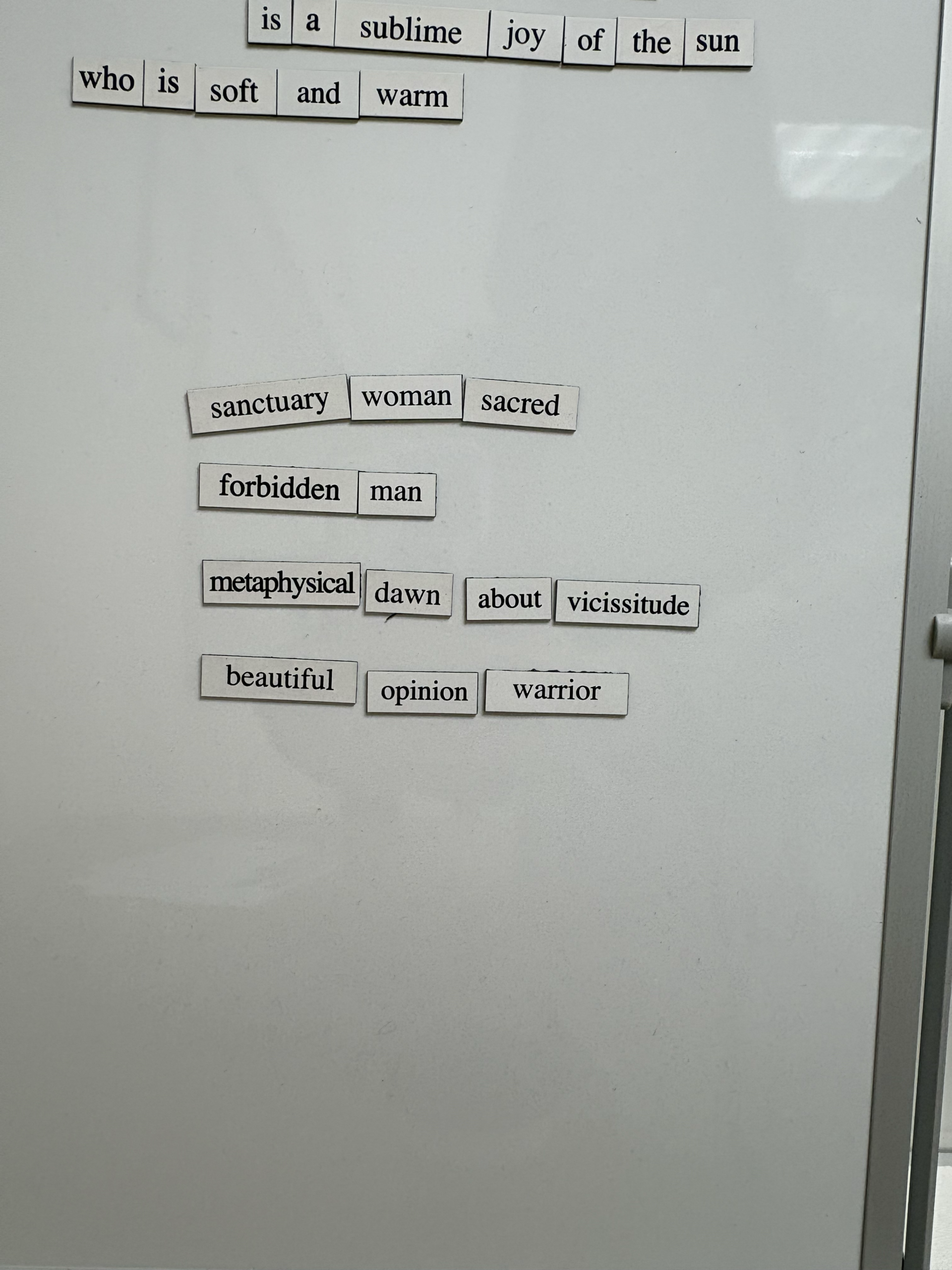
I thought I’d post the first draft of my Dickinson-inspired poem written for Response 4 here. I ended up writing something a little different, but want to preserve the first version. I hope everyone has a great weekend!

It may be Me – the Fool

Should no one take – my place –

Or should I heave the Rock – or roll it,

Beyond the bars of plywood gate 

I keep in store – Your every – Joy –

My Heart – engulfed – too heavy 

But still – to Jump – I fight the weight 

The Bearer, and You – devoid – but Victory

Poem #867

I feel like I understood some of the meaning of this poem, but sometimes I struggle to understand significance in intentional capitalization. For example, Dickinson capitalizes “Cleaving” (1), “Brain” (2), “Seam” (3), “Sequence” (7), etc. I’m having a hard time understanding some of the deeper possible meanings here besides just emphasizing the words.

This is my April 2nd work

Poems #528 & #588:

It’s well known that Dickinson discusses the concept of death in a variety of her poems. From my understanding and interpretation of them, these two poems approach death in different ways, however they possess similar meanings

Within #528, Dickinson describes death as peaceful, an escape from the suffering that is living. Death waits for us kindly “behind the Door-” (4). I really like how she uses birds as a metaphor in this poem. When weathers get harsh and unbearable, some birds migrate to warmer temperatures and easier living conditions. Humans “are the Birds – that stay” (8). Oftentimes in our lives there is no option to migrate to a new climate or easier circumstance. We live through what we’re given for better or for worse, we’re desperate birds, searching for the light in all our darkness. The second two stanzas describe the suffering in living, however the poem is introduced by the savior of death. Dickinson writes that living is worse than dying and that there’s something peaceful in the concept of an eternal rest waiting for us.

While poem #588 still discusses suffering, it talks less about life itself and more regarding the emotional experience as a human and psychological progression. It infers that the desire to die slowly builds throughout life, it is our final privilege we are given. The heart, one of the prominent figures in this poem, is gradually worn out by emotional suffering and begins to seek the peace in death. It first “asks Pleasure” (1), and then when reality settles, all the heart desires is an excuse “from Pain” (2). This poem connects to the prior one in that they illustrate death as a relief or a reward from life. I believe death is a very daunting topic- it can often be difficult and uncomfortable to think about existential topics like it. However, in these two poems I think Dickinson provides a very beautiful perspective on death that makes the idea of it a little less scary. While I don’t fully agree that all of life is suffering, I do think her approach can be fitting.

Both poems highlight death. However, the first reveals human endurance through hardships and the second portrays the heart’s eventual surrender to emotional pain.